

In the flat, fog-bound plains of the Veneto region, specifically within the strictly defined territories of Treviso, Padua, and Venice, there exists a botanical paradox that defies the standard definition of agriculture, a vegetable that requires the metaphorical death of winter to be truly born and a process of manipulation so complex and labor-intensive that it borders on artisanal torture. This is the Radicchio Rosso di Treviso IGP Tardivo, often venerated as the “Winter Flower” or the “Edible Orchid,” and to mistake it for a common salad ingredient is a culinary heresy that ignores centuries of peasant ingenuity and agronomic science.
Its lifecycle is a slow-burning drama in three distinct acts, beginning in the open fields of high summer when the seeds are sown, producing a plant that, by late October, looks nothing like the elegant red-and-white spear found in markets; in fact, it looks utterly unappetizing, a chaotic, sprawling mess of green, ragged leaves that appear almost weed-like. While other crops are harvested before the cold sets in, the Tardivo waits for the punishment of the climate, needing at least two hard frosts in November to trigger its internal survival mechanism, a vegetative stasis that arrests the plant’s growth and concentrates its sugars.
But the harvest, which occurs in the freezing mud of late autumn, is not the end of the road; it is merely the prologue to the most crucial phase, known as “Pre-forcing,” where the plants are dug up with their long taproots still fully attached and intact, shaken of the heavy clay soil, and tied into large, muddy bundles. These bundles are not sent to the market but are transported to dark, indoor facilities—often converted stables or specialized greenhouses—for the phase that defines its nobility and justifies its high price: the Imbianchimento (whitening or blanching). Here, the roots are submerged in large tanks of running spring water, traditionally drawn from the Sile River aquifer, which bubbles up at a constant temperature of 11 to 13 degrees Celsius, acting as a thermal blanket against the freezing air, while the leaves above are kept in absolute, pitch-black darkness. It is here, in this marriage of “darkness and water,” that the alchemy occurs over the course of fifteen to twenty days; the plant, deceived by the warmth of the water at its feet but deprived of light for photosynthesis, wakes up from its winter slumber and, in a desperate attempt to seek the sun, begins to sprout a new heart from its center. Because there is no light, the plant cannot produce chlorophyll (which would make it green and bitter), and instead, it cannibalizes its own outer green leaves, sucking the nutrients from them to feed the new growth, which emerges pure, porcelain-white with intense, violet-red tips, rich in anthocyanins and crisp with water.
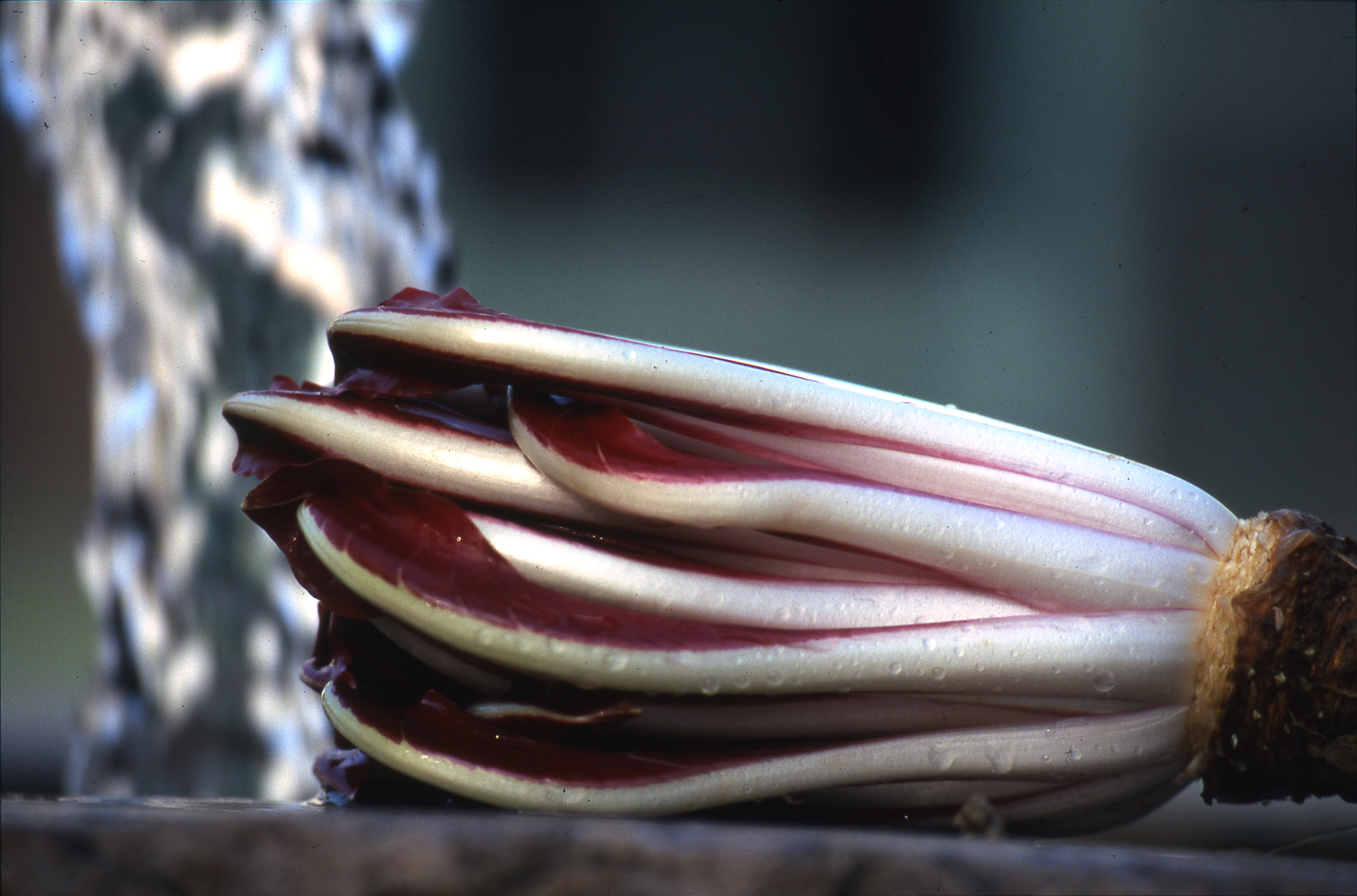
The final act of this transformation is the toelettatura (grooming), a brutal and precise manual process performed by skilled artisans who strip away the rotten, muddy, and depleted outer layers—discarding roughly 70% to 80% of the plant’s total biomass—to reveal the precious inner core, carving the root with a small, hooked knife until it is white and clean, resembling a bone or a stake. This immense waste explains the cost; you are paying for the 80% of the plant that was sacrificed to create the 20% of perfection. The result is a vegetable that is visually stunning, with curled ribs that look like tentacles of blown Venetian glass, and a texture that is unique in the vegetable kingdom: solid, crunchy, and able to retain its bite even when cooked. The flavor profile is a sophisticated balance of opposites, where the aggressive bitterness of the chicory family is tamed by the blanching process, leaving behind a pleasant, tannic background note that supports a surprising sweetness and a distinct mineral finish.
In the kitchen, the Tardivo is treated with the reverence usually reserved for truffles or porcini mushrooms; it is the protagonist of the noble Risotto al Radicchio, where its crunch contrasts with the creaminess of the rice, or it is grilled simply with olive oil to enhance its smoky, nutty notes, or even eaten raw, dipped in seasoned olive oil (pinzimonio), serving as a powerful digestive and a cleanser for the palate after fatty winter meats. Its history is a blend of truth and legend, with some attributing the invention of the blanching technique to a Belgian landscape architect, Francesco Van Den Borre, who brought the method of whitening chicory to Treviso in the 1860s, while others claim it was a happy accident discovered by peasants who stored the chicory in warm stables to keep it from freezing, noticing that the hearts turned white and sweet.
Regardless of its origin, the Radicchio Tardivo today is the symbol of the Venetian winter, a crop that supports hundreds of families and creates a landscape of “water gardens” hidden inside dark barns, reminding us that in this region, the most beautiful things are not given by nature, but are conquered from the mud, the cold, and the dark through the sheer stubbornness of human labor.
Discover more from The Ambassador
Subscribe to get the latest posts sent to your email.