

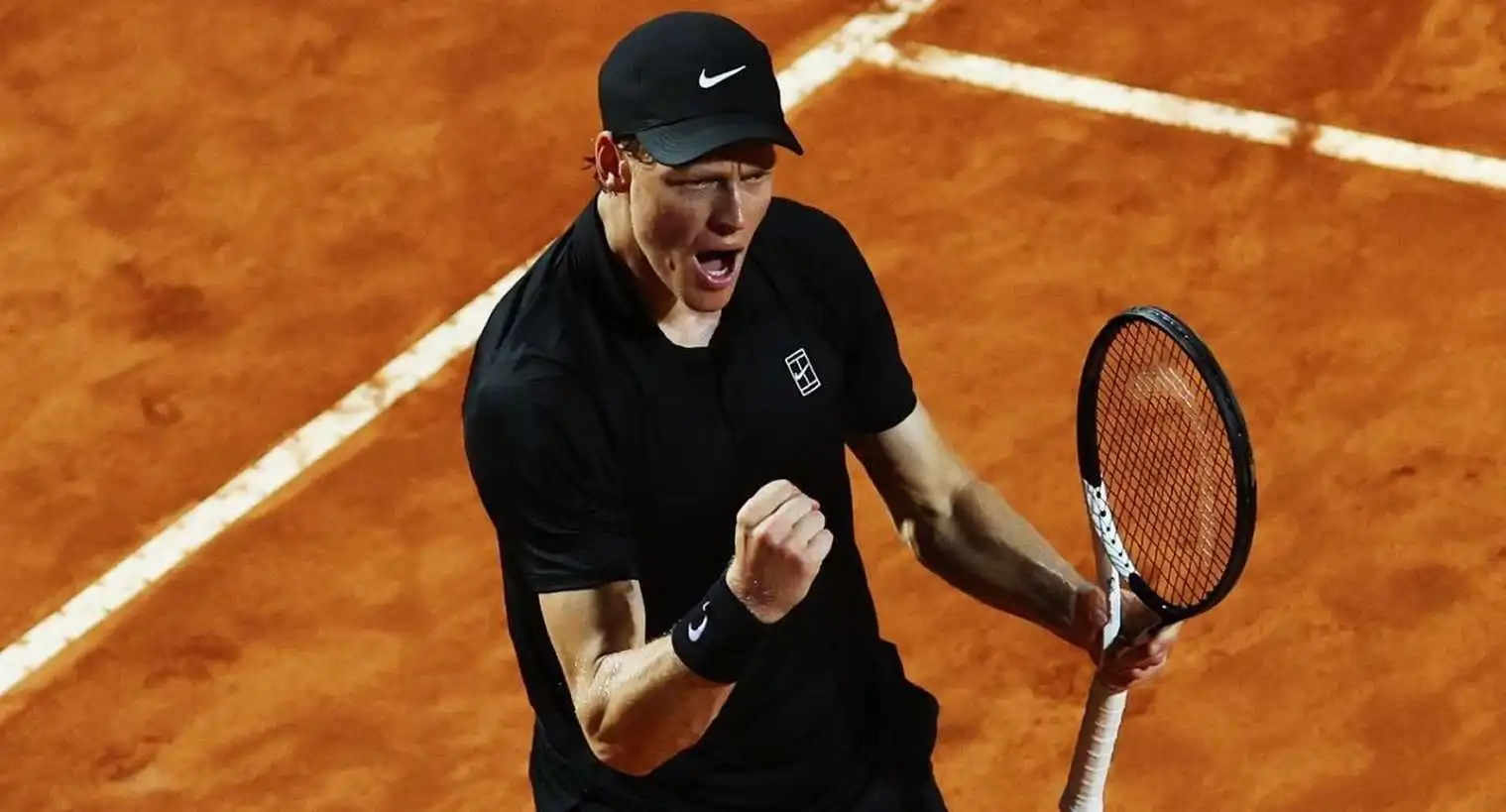
Rome didn’t just witness a tennis match; it celebrated the definitive consecration of an era. On a Sunday kissed by the May sun, the Center Court of the Foro Italico transformed into the epicenter of a collective enthusiasm that Italian tennis had been waiting for half a century. Jannik Sinner lifted the Internazionali BNL d’Italia trophy to the sky, overcoming the Norwegian Casper Ruud in the final with a mirrored score: 6-4, 6-4. A triumph that arrived at the end of a flawless week, void of any real hesitation, certifying the Italian tennis player’s status as absolute dominator and sending the entire country into a frenzy.
The passing of the baton: from Panatta to Sinner, fifty years later
There is an archaeology of sporting emotions that, in the shade of the Foro Italico’s cypress trees, has always found its highest expression. For fifty years, Adriano Panatta’s success back in 1976 remained an intangible totem, a glorious yet faded memory, almost a curse for subsequent generations of Italian tennis players, systematically crushed by the weight of that comparison. Today, that thread of history, broken for five decades, has finally been tied back together, completing a perfect and evocative generational passing of the baton.
If Panatta’s 1976 victory was the triumph of genius and unpredictability, of pure instinct, backhand smashes, and match-points saved with Roman audacity, Sinner’s victory represents the triumph of geometric modernity, scientific dedication, and glacial composure applied to talent. Two seemingly opposite Italian tennis souls—the exuberant Roman sunshine versus the silent Alpine determination—that today merge in the same roll of honor. Panatta has ideally handed the keys of the Center Court over to Sinner, recognizing in him not just an heir, but the global leader capable of pushing Italian tennis to previously unexplored heights.
Match chronicle: a symphony of power and control
The match against Casper Ruud, one of the most solid and formidable clay-court specialists internationally, was an essay in tactical maturity. From the very first rallies of the opening set, Sinner made his intentions clear: attacking the ball on the rise to take time away from the Norwegian, preventing him from unleashing his devastating, heavy-topspin forehand.
The first set unfolded along lines of apparent balance, but with the Italian constantly in control of his service games thanks to an extremely efficient serve. The turning point came at 4-4: Sinner raised the intensity of his returns, forcing Ruud into errors and securing the decisive break. With disarming coolness, the 24-year-old from Sesto Pusteria then served for the set, closing the fraction at 6-4 amidst the roars of the crowd.
In the second set, Ruud attempted a reaction by varying his trajectories and seeking greater depth, but Sinner proved that he had also completed his defensive evolution on clay. Sliding with extraordinary naturalness and covering every inch of the court, the South Tyrolean frustrated every comeback attempt by the Norwegian. A new, surgical break in the middle of the set carved out the final gap. Fueled by the incessant chanting of the seven thousand fans on the Center Court, Sinner did not tremble when it was time to close the deal, sealing the match with another 6-4 and exploding into a liberating smile.
Handling the pressure and the impact on the Italian movement
Winning in Rome, for an Italian tennis player, is historically considered the most complex psychological hurdle of all. The passion of the Roman crowd can be a formidable engine, but also a paralyzing cage of expectations. In past years, many Italian champions have buckled under the weight of this responsibility. Sinner, on the contrary, has shown he knows how to transform pressure into pure energy. His composure in the key moments of the tournament—from his opening matches to the final act—highlights a mental toughness that clearly distinguishes him from the rest of the tour.
This success is not isolated but crowns a journey that in recent years has seen Italian tennis regain absolute centrality in the global sports landscape, thanks to structural investments and a new work culture of which Sinner is the ultimate ambassador.
Clay has a new master: sights set on Paris
With the Internazionali d’Italia trophy in his cabinet, Jannik Sinner’s clay-court season takes on a frightening shape for his opponents. Clay, a surface that at the beginning of his career seemed the least suited to his flat accelerations, has fully become a terrain of conquest and physical dominance.
The success at the Foro Italico sends a clear and peremptory signal to the entire ATP tour ahead of the upcoming Roland Garros. While the Capital enjoys the celebrations for its new king, the tennis world shifts its gaze to the courts of Paris. Sinner will arrive in the shadow of the Eiffel Tower not only as the odds-on favorite, but with the historical awareness of someone who has just shattered the ultimate taboo of Italian tennis.
Discover more from The Ambassador
Subscribe to get the latest posts sent to your email.