

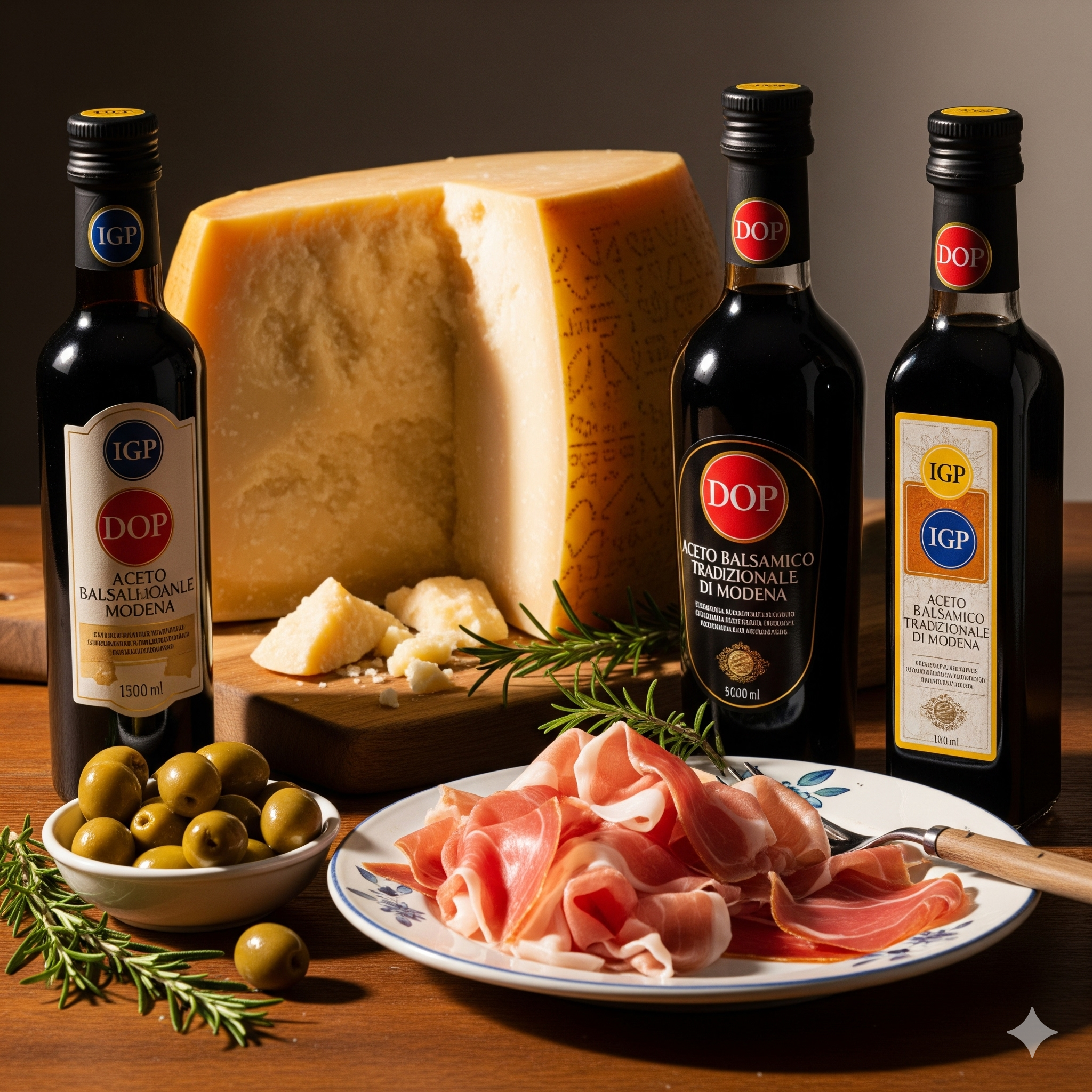
Walk into any high-end food market from London to Los Angeles, and you will find a quiet battle being waged on the shelves. On one side, a wedge of cheese is labelled simply “Parmesan.” On the other, a visually similar wedge bears the name “Parmigiano Reggiano” and a small, colourful seal. To the uninformed shopper, the difference may seem trivial. In reality, that seal represents the frontline of a multi-billion-euro industry and a fierce, ongoing struggle to protect the soul of Italian food. This is the world of DOP and IGP certifications, a complex system of legally binding guarantees that underpins the global reputation of “Made in Italy” and ensures that a product is not just a food, but a genuine, inimitable piece of a specific Italian place.
To understand the power of this system, one must first decode the alphabet of quality. The most stringent and prestigious of these certifications is DOP, or Denominazione di Origine Protetta (Protected Designation of Origin). This is a holistic guarantee. For a product to earn the coveted DOP seal, every single step of its creation, from the raw materials to the final processing and aging, must occur within a strictly defined geographical area and adhere to a meticulous rulebook, the disciplinare. The quintessential example is Parmigiano Reggiano DOP. The milk must come from specific breeds of cows, raised on local forage within the provinces of Parma, Reggio Emilia, Modena, and parts of Bologna and Mantua. The cheese must be made according to ancient methods and aged for a minimum of 12 months within that same area. Nothing can be imported; nothing can be outsourced. It is a product indivisible from its territory.
Slightly more flexible but equally important is IGP, or Indicazione Geografica Protetta (Protected Geographical Indication). For an IGP product, at least one, but not all, of the phases of production must occur in the designated geographical area. A classic example is Aceto Balsamico di Modena IGP. While the grape must can be sourced from various regions, the crucial processes of blending it with wine vinegar and aging it in wooden barrels must take place in the province of Modena. The IGP label guarantees that the essential character and quality of the product are tied to its geographical origin.
These certifications are far more than just a bureaucratic exercise; they are a powerful economic engine. According to the 2024 Ismea-Qualivita report, the Italian DOP and IGP economy is worth over €20 billion in production value, with exports exceeding €11 billion annually. These certified products command a premium price on the global market, supporting the economies of entire regions and employing hundreds of thousands of people. Culturally, the disciplinare for each product acts as a living archive, preserving biodiversity by mandating the use of local animal breeds and plant varieties, and safeguarding traditional production methods that might otherwise be lost to industrial homogenization. They are a legal defense against the delocalization of Italy’s most precious cultural and gastronomic assets.
The need for such a robust defense is made clear by the pervasive global problem of “Italian Sounding.” This term refers to the vast market of products that use Italian-sounding names, colours, and imagery to deceive consumers into believing they are authentically Italian. It is a fraudulent industry estimated to be worth over €60 billion a year—more than double the value of Italy’s actual food exports. This is the world of “Parma Ham” made in Canada, “Asiago” cheese from Wisconsin, and “Chianti” wine produced in California. These products not only steal market share from legitimate producers but also erode the value of the “Made in Italy” brand by associating it with inferior quality.
Leading the global war against this fraud are the Consorzi, the powerful consortiums or guilds of producers for each DOP and IGP product. The Consorzio del Parmigiano Reggiano, for example, acts as a global brand guardian. It employs inspectors who check the quality of every single wheel of cheese, fire-branding the authentic ones with the iconic dotted seal. Its legal teams scan global markets, fighting in and out of court to block the sale of counterfeit “Parmesan.” These consortia work with national fraud prevention bodies like the ICQRF to seize fake products and pursue legal action, and they lobby intensely for the recognition and protection of their geographical indications in international trade agreements. In a globalized food system that often prioritizes quantity over quality and imitation over authenticity, Italy’s DOP and IGP system is a powerful counter-narrative. It is a legally-enforced promise to the consumer: what you are buying is not just a product, but a story, a tradition, and the unique taste of a specific Italian place. It is a pact between the land, the producer, and the consumer, sealed in law and tradition. This tireless battle to protect its certified treasures is not just a defense of its gastronomic heritage; it is Italy’s most potent and valuable strategy for the future of food.
Discover more from The Ambassador
Subscribe to get the latest posts sent to your email.