


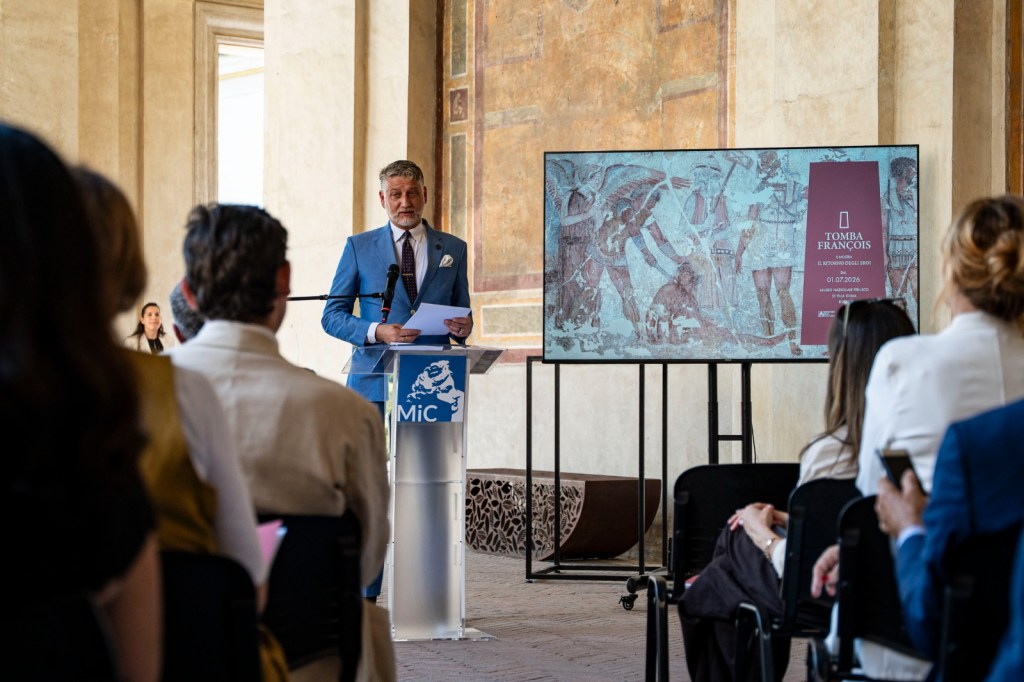
Rome, June 30, 2026 — Italy’s cultural heritage is celebrating a monumental triumph. The renowned François Tomb, widely considered one of the greatest masterpieces of Etruscan painting and ancient art, has officially returned to the public heritage of the Italian State. The formal announcement was made by the Minister of Culture, Alessandro Giuli, during his speech at the National Etruscan Museum of Villa Giulia for the inauguration of the exhibition dedicated to this extraordinary hypogeum monument.
A Century-Long Negotiation
Bringing the François Tomb under public control marks the culmination of a massive, long-standing institutional effort. As Minister Giuli emphasized, the Italian State had been attempting to acquire the archaeological site since as far back as 1914.
“The return of the François Tomb to public heritage is a historic milestone. Since 1914, the Italian State has been trying to acquire it, and today, finally, we pass it down as a legacy to the younger generations.” — Italian Minister of Culture, Alessandro Giuli
The Ministry Joins the Vulci Foundation
Beyond celebrating the restitution of the monument, the event at Villa Giulia served as the backdrop for a second major strategic announcement for Italian archaeology. Minister Giuli officialized the Ministry of Culture’s (MiC) intention to permanently join the Vulci Foundation.
This decision stems from a clear goal to directly contribute to the protection and promotion of one of Europe’s most significant archaeological sites. It will also strengthen ongoing collaboration with local institutions and the surrounding territory. The Ministry’s entry into the foundation will enable more synergistic management, targeted resources, and long-term planning for the entire Vulci Archaeological Park.
Unearthing Millennia of Heritage
The François Tomb is not only an invaluable artistic treasure but also a crucial historical record for understanding ancient Italy.
“The François Tomb preserves a fundamental part of our history,” the Minister explained. Its vivid depictions narrate the deep roots of the Etruscan civilization, its complex relationship with Rome, and their shared Mediterranean legacy.
In Giuli’s words, the public restoration and promotion of this masterpiece prompt a profound reflection on the very nature of the nation’s identity:
“It reminds us how Italian identity is the result of a millennial history, shaped by encounters, transformations, and sharing.”
— Italian Minister of Culture, Alessandro Giuli
With this operation, officially concluded in late June 2026, Italy reaffirms the centrality of its historical memory, rescuing a monument from private oblivion so that it remains accessible to the public from this day forward.
Source: “MiC” (Italian Minister of Culture) Press Office
Discover more from The Ambassador
Subscribe to get the latest posts sent to your email.