

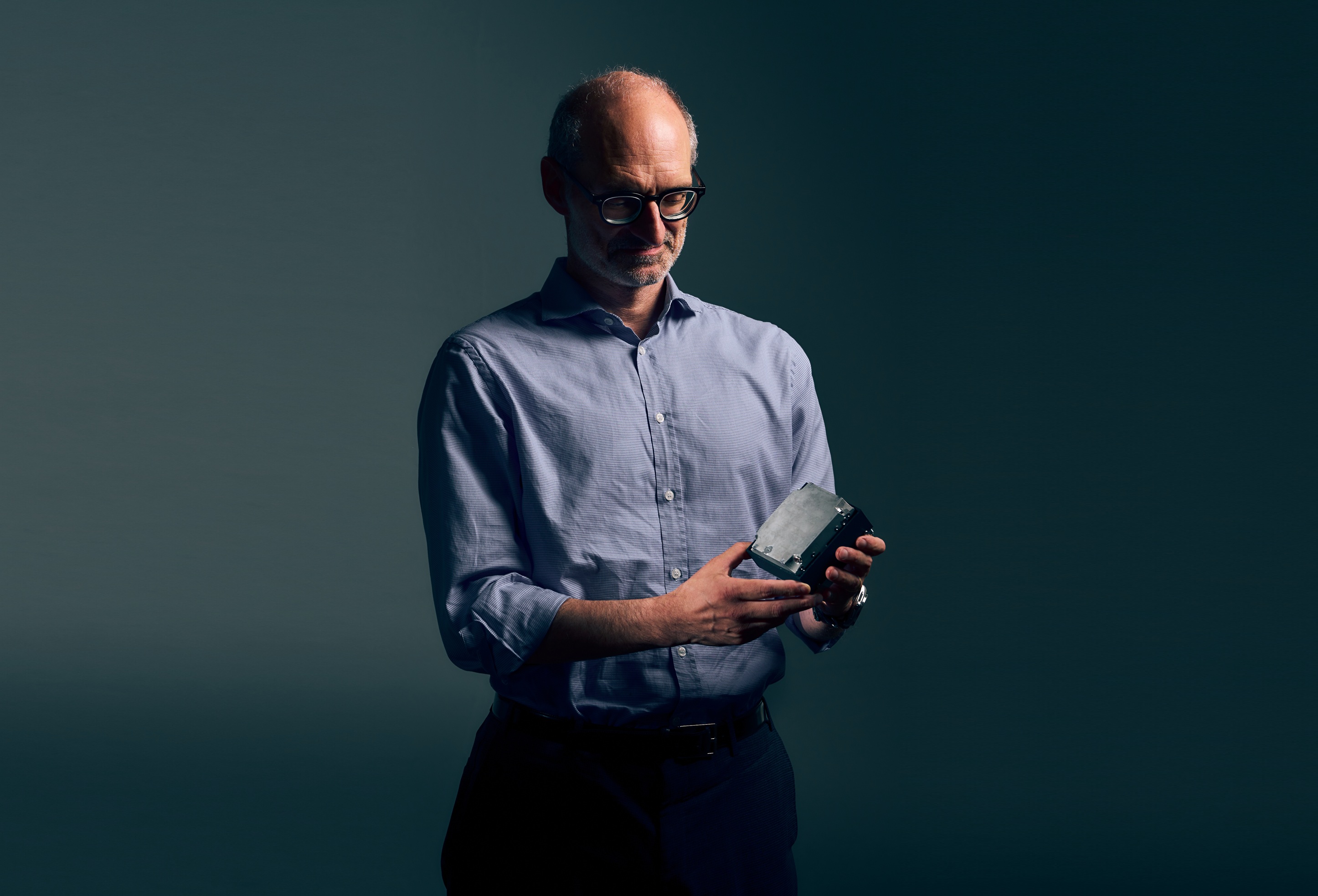
The exploration and commercial exploitation of space are experiencing an unprecedented acceleration. In this highly competitive landscape, Italian companies are demonstrating an innovative capacity that positions them at the forefront of the international aerospace market. Confirming the sector’s dynamism is the recent participation of T4i (Technology for Propulsion and Innovation) on the ‘Challenge’ podcast, available on Amazon Music. During the discussion with host Matteo Valléro, it clearly emerged how the design and commercialization of motors for small satellites are redefining the rules of engagement for accessing Earth’s orbit, transforming technological challenges into concrete business opportunities.
Mr. Pavarin, during the podcast, the theme of continuous innovation emerged repeatedly. What is the primary engineering and economic obstacle that your company had to overcome to make its propulsion systems globally competitive?
“From an engineering standpoint, the main obstacle is the need to combine high performance with sustainable costs. Historically, space propulsion systems were extremely expensive, albeit highly reliable, as they were the result of very long development processes. With the advent of micro-platforms and the modern space economy, a strong demand for cost-effective solutions has emerged. The true technical challenge, often underestimated in the aerospace sector compared to terrestrial industries, is precisely identifying the best compromise between reduced costs, repeatable high quality, and elevated performance; a paradigm that is breaking through disruptively in space only now.
At an economic and financial level, companies face complex choices. On one hand, there is the option to rely on Venture Capital funds to secure massive financial flows, while accepting heavy constraints and the risk of forced, unbalanced growth. On the other hand, one can opt for a more gradual and structured path. We chose this latter path to ensure maximum corporate resilience. Although this entails more contained growth compared to some competitors in the short term, it allows us to keep our finances in order, remain self-sustaining, and grow in an economically sustainable manner.“
The Versatility of Small Satellite Motors
The answer to the changing needs of an increasingly populated orbit lies in maximum engineering versatility. To guarantee longevity and maneuverability to space equipment, the Padua-based company has developed a fluid and articulate technological portfolio covering every phase of a mission, eliminating the rigidities of the past.
From the cold gas reactive systems of the Ianus and Perseus families, ideal for proximity operations and rapid evasive maneuvers, the selection transitions to the Regulus motors—electric systems among the first in the world to use solid iodine as a propellant, developed for missions requiring complex orbital adjustments or long-term low-Earth orbit maintenance. The range continues with the ALPHARD systems, HTP monopropellant motors suitable for attitude control and the propulsion of small and medium platforms. These are followed by the KUMA bipropellant systems, also based on HTP, intended for the primary propulsion of medium and large platforms.
Completing the offering are the TEIDE motors, with thrusts exceeding 10 kN, based on a hybrid architecture and HTP oxidizer, developed for a new generation of air-launched vehicles. The chemical systems in the range—KUMA and TEIDE—can also be pressurized using innovative electric pumps entirely developed by T4i, a solution that reduces the complexity of traditional pressurization systems while increasing operational flexibility, scalability, and propulsion system performance. This complete range of technologies allows operators to optimize costs and maximize the performance of assets in flight.
Economic and environmental sustainability is a crucial issue even outside Earth’s atmosphere. How do your propulsion systems practically help commercial operators mitigate the growing and concerning problem of space debris?
“Europe is at the forefront of this issue, as its Agency has most courageously introduced stringent end-of-life decommissioning policies, requiring platforms to be moved into harmless orbits or re-entered into Earth’s atmosphere. In this context, the propulsion system is the enabling element par excellence for keeping orbits clean. The European Space Agency has made its use virtually mandatory; without a motor, it is extremely difficult to guarantee a satellite’s controlled re-entry, especially in an era of space overcrowding with the imminent launch of constellations composed of thousands of satellites.
All of this imposes significant engineering challenges. Propulsion systems must remain fully operational until the end of the satellite’s useful life, enduring long periods in hostile environments filled with radiation. Furthermore, there is the fundamental issue of demisability: the entire motor, including the propellant, must be able to burn and vaporize completely during atmospheric re-entry to prevent dangerous debris from falling to Earth. This requires the use of highly innovative materials capable of storing propellant at high temperatures but disintegrating in total safety during the re-entry phase.“
Talent and Capital in the Aerospace Business
The development of these cutting-edge technologies requires not only technical intuition but also a solid capital structure and a constant influx of new professional skills. The international market has historically been dominated by government giants and large industrial conglomerates, making competition particularly complex for new players.
However, the strategic bridge that agile entities like T4i manage to build between top-tier academic research and the pragmatism required by the manufacturing industry represents an invaluable competitive advantage. It is this close synergy that attracts both targeted investments from venture capital funds and young engineering talents eager to shape the future of extra-atmospheric mobility.
Being an Italian company in a market dominated by international giants represents a complex challenge. How do you manage to constantly attract the human and financial resources necessary to maintain leadership in research and development?
“It is a complex challenge because we compete with foreign entities that possess nearly non-existent spending limits. To attract human resources, we compensate for the purely financial difference—which is difficult to bridge against large international groups—by proposing a clear vision and focusing on the high quality of life that Italy can offer.
We offer our collaborators flexibility, the real possibility to put their ideas into play, and the invaluable advantage of feeling at the center of an environment where the person is the crucial element, not a mere number. The financial aspect is undoubtedly important and receives maximum attention, but we are convinced that sharing a grand dream is even more vital.“

The Future of Orbital Mobility
Looking at medium-term industrial prospects, the sector’s trajectory indicates an ever-increasing demand for components that are simultaneously lightweight, safe, and economically sustainable. The ability to offer the global market high-performance motors for small satellites translates directly into a true democratization of space access.
The paradigm has changed: it is no longer just a matter of launching expensive instruments into orbit, but of managing their entire life cycle in total safety, paving the way for new and profitable services linked to telecommunications, high-resolution Earth observation, and scientific experimentation.
Looking toward the horizon of the next decade, what do you predict will be the commercial evolution of propulsion systems, and what are the most imminent industrial expansion goals you intend to achieve?
“In the next decade, propulsion systems will become a true commodity for all satellites. They will be indispensable assets for executing deorbiting and, above all, for the collision avoidance maneuvers required to avoid obstacles in orbit, as this capability extends and maximizes the profile of every mission. It will be unthinkable to design a satellite devoid of mobility.
Consequently, we expect strong and continuous market expansion. As T4i, we are working to plug into this growth by following two strategic avenues: on one hand, the continuous development of proprietary products and technologies ; on the other hand, the construction of targeted alliances. We are deeply convinced that SMEs in the sector must evaluate strategic partnerships and band together, both with major players and among themselves, to present themselves on global markets in a solid and competitive manner.“
The words and strategic vision shared in front of Amazon Music’s microphones outline an extremely clear picture, where national engineering talent does not merely participate passively in the new space race but dictates its pace and technological directions. Providing propulsive intelligence and directional thrust to the vehicles of the future means consolidating true technological and economic sovereignty. The global space industry is destined to expand exponentially in the coming years, and its true engine, now more than ever, continues to push proudly in Italian.
Discover more from The Ambassador
Subscribe to get the latest posts sent to your email.