

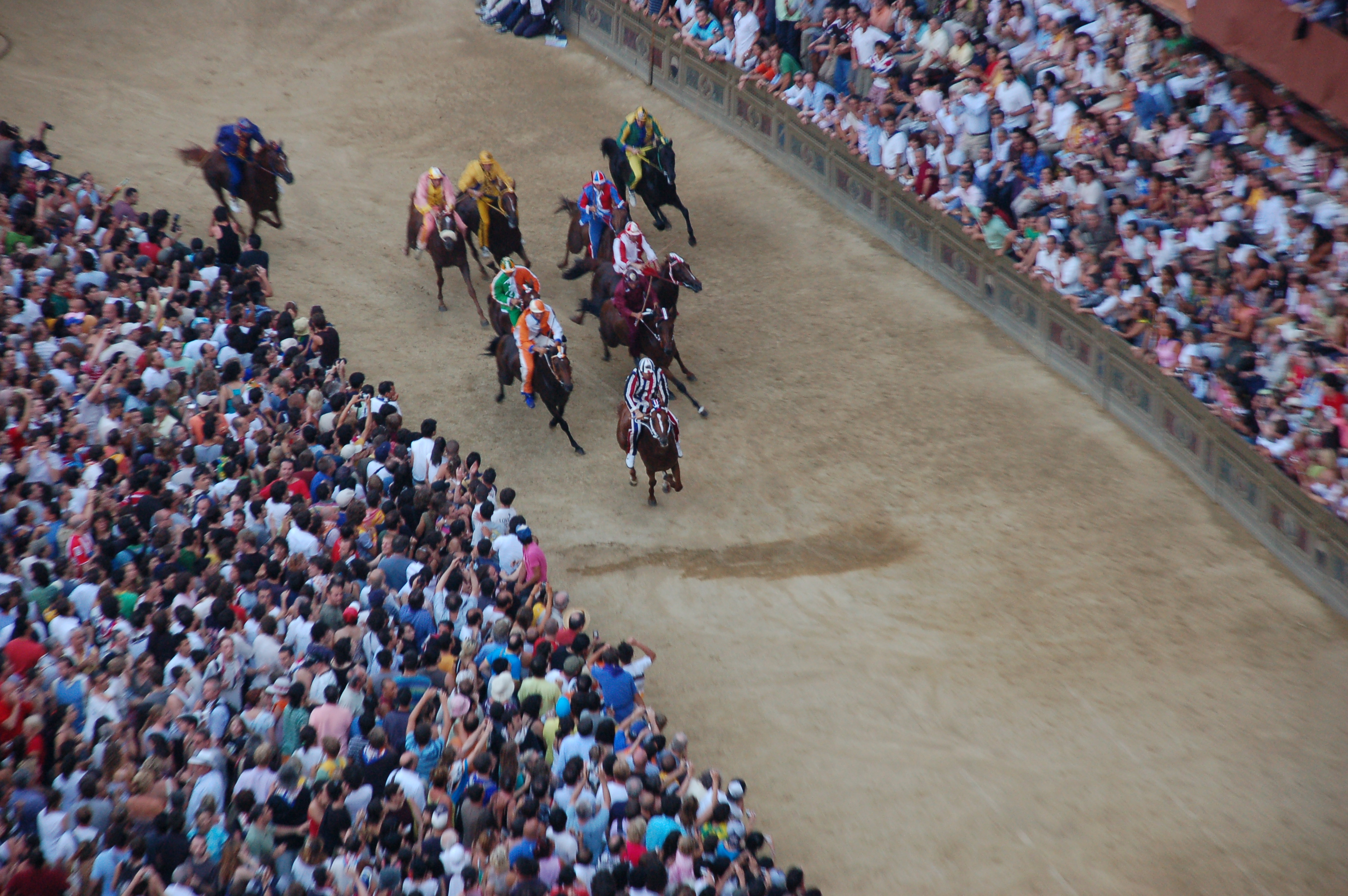
In the stark, uncompromising light of the Tuscan summer, the magnificent shell-shaped expanse of Piazza del Campo in Siena transforms into a theater of pure, unadulterated human and kinetic intensity. The Palio is frequently, and entirely erroneously, categorized by the superficial global observer as a mere historical reenactment or a colorful tourist spectacle. In absolute reality, it is a fierce, deeply visceral, and highly uncompromising anthropological mechanism that dictates the fundamental psychological and economic survival of an entire city. Stripped of the vibrant, highly saturated heraldic colors that typically define its public image, the monochrome photographic lens exposes the raw, structural truth of the event. It is a world carved in absolute high contrast: the blinding, sun-bleached expanse of the packed tufa dirt violently colliding with the pitch-black, looming shadows of the Palazzo Pubblico; the deeply lined, fiercely concentrated faces of the Sienese citizens locked in a state of almost terrifying civic devotion; and the heavy, muscular tension of the horses waiting blindly at the starting line. This is the beating, indestructible heart of an Italy that completely refuses to commodify its soul, presenting the global elite with a masterclass in how ancestral loyalty can successfully engineer an impenetrable, highly capitalized social architecture.
The Micro-State Syndicates
To truly comprehend the monumental gravity of the Palio, one must completely bypass the ninety seconds of the physical race and analyze the sophisticated, highly organized structure of the seventeen Contrade (city wards). These entities do not function as mere neighborhood associations; they operate as fully autonomous, highly disciplined micro-states, each possessing its own strict constitution, territorial boundaries, historical museums, and, crucially, independent financial treasuries. From a deeply sociological perspective, the Contrada provides an absolute, cradle-to-grave social safety net for its members, fostering a level of intergenerational cohesion and psychological resilience that modern, highly individualized Western metropolises have entirely lost.
In the heavily shadowed, ancient stone alleyways of the city, the monochrome aesthetic perfectly captures the immense physical and emotional weight of this belonging. The intense, unyielding gaze of a Contrada Prior, the heavy, rhythmic drumming that echoes violently against the narrow medieval masonry, and the collective, deeply resonant chanting of thousands of local citizens create a profoundly intimidating, deeply moving acoustic and visual environment. This internal societal structure demands an absolute, unquestioning loyalty, demanding significant financial and personal contributions from its members to sustain the immense logistical operations of the ward. It is a closed, highly secretive, and fiercely proud ecosystem where social status is never determined by external corporate wealth or global fame, but entirely by the depth of one’s absolute devotion to the ancestral territory.
Intellectual Property and Absolute Exclusivity
From a rigorous macroeconomic and corporate governance perspective, the city of Siena and its Contrade execute what is arguably the most fiercely successful, unyielding defense of intellectual property in the modern cultural world. The Magistrato delle Contrade operates with a relentless, highly aggressive legal precision to completely crush any unauthorized commercial exploitation of their heraldic symbols, historical imagery, or the name of the Palio itself. Multinational corporations, global fashion conglomerates, and international broadcasting syndicates have repeatedly attempted to purchase, sponsor, or commodify the race, only to be met with a spectacular, uncompromising wall of absolute refusal. The Palio is never for sale.
This strict, almost aggressive anti-commercial stance generates a brilliant, highly counterintuitive economic paradox. By absolutely refusing to mass-market their identity, the Sienese have inadvertently created the ultimate, most coveted luxury asset on the European continent: pure, unadulterated authenticity. Because the event cannot be bought, sponsored, or artificially replicated, it commands a staggering premium in the global experiential economy. Ultra-high-net-worth individuals, elite international dignitaries, and private wealth syndicates eagerly deploy massive volumes of capital to secure highly coveted, private balcony access overlooking the Piazza del Campo. This intense, highly concentrated influx of elite foreign capital heavily subsidizes the hyper-luxury real estate market surrounding the piazza and drives the premium hospitality sectors of the adjacent Chianti and Brunello wine territories, proving definitively that the absolute defense of cultural purity is an immensely powerful, highly lucrative economic strategy.
Kinetic Violence and Equine Majesty
The physical execution of the race itself is a breathtaking, terrifying display of raw biological power and extreme human risk. Ten horses, ridden entirely bareback by specialized, highly aggressive jockeys known as fantini, are violently launched onto a treacherous, highly irregular track of packed earth that offers absolutely no modern safety concessions. The stark black-and-white photography captures this explosive kinetic energy with heart-stopping clarity: the massive, heavily muscled chests of the equines violently tearing through the heavy, suffocating clouds of rising dust; the sharp, agonizing angles of the infamous San Martino curve where centrifugal force threatens to shatter both man and beast; and the desperate, violently twisting bodies of the jockeys as they aggressively utilize their ox-hide whips to command the space.
There is absolutely no space for romanticized equestrian elegance within this arena; it is a brutal, high-stakes battle for territorial supremacy where the horse itself is revered with a deeply profound, almost religious awe. The animal is the absolute protagonist, highly protected and deeply respected by the Contrada that receives it through a blind, highly tense lottery. When the winning horse finally crosses the finish line, regardless of whether the human jockey is still mounted upon its back, the resulting explosion of collective human emotion is staggering. The monochrome lens freezes the violently weeping faces of the victorious citizens as they aggressively swarm the track to claim the Drappellone—the painted silk banner that serves as the sole, highly sacred prize.
The Architecture of Eternal Memory
To witness the immediate aftermath of a Palio victory is to observe the complete, masterful collapse of modern emotional restraint. The triumphant Contrada embarks on a continuous, highly intense celebration that physically overtakes the streets for months, culminating in massive, highly architectural victory banquets where thousands of citizens dine together at endless tables winding through the medieval urban fabric. The deep, heavy shadows of the historic palazzos provide a monumental backdrop to these deeply visceral expressions of joy and territorial dominance.
The enduring legacy of the Palio is a profound, highly aggressive assertion of Italian resilience. It successfully challenges the international elite to fundamentally re-evaluate their understanding of societal wealth, demonstrating that the most valuable, indestructible assets of a nation are not merely its gold reserves or its digital infrastructure, but the fierce, unyielding devotion of its people to their ancestral soil. The Ambassador proudly delivers this heavily textured, deeply dramatic reality to its universal readership, offering an exclusive initiation into an Italy that violently refuses to surrender its historical memory to the sterile forces of globalization. It is an invitation to discover a territory where history is not a passive museum exhibit, but a living, breathing, and fiercely roaring beast that continuously commands the ultimate respect of the contemporary world.
Discover more from The Ambassador
Subscribe to get the latest posts sent to your email.