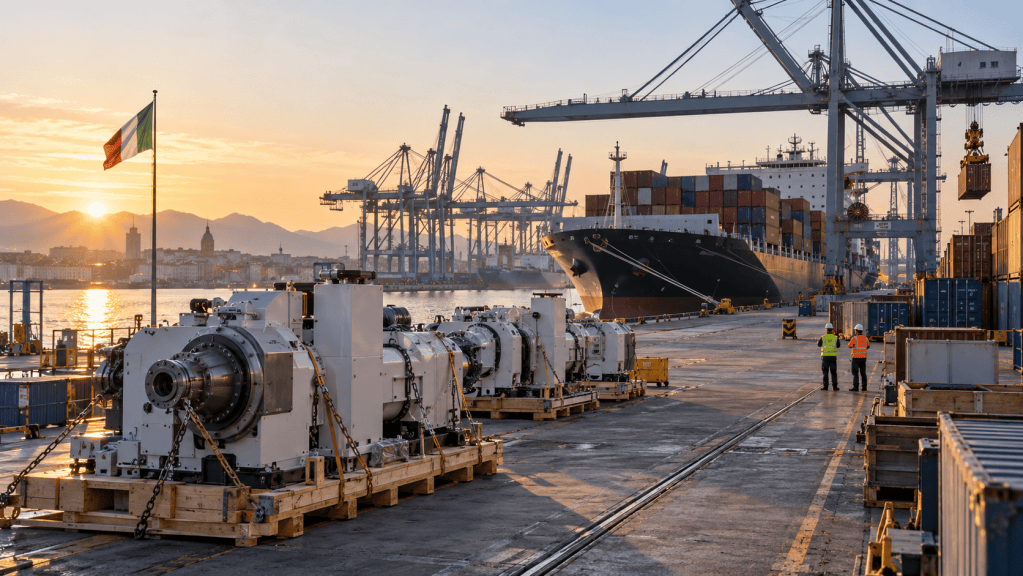


A ship leaving an Italian yard carries more than the work of the people who built its hull. It embodies the efforts of engineers, software developers, propulsion specialists, furniture makers and countless component suppliers. A busy port, likewise, supports rail operators, warehouses and inland manufacturers. This is the scale on which to understand Italy’s “blue economy”: the collection of industries that use, serve or depend on the sea, and the much broader network they set in motion.
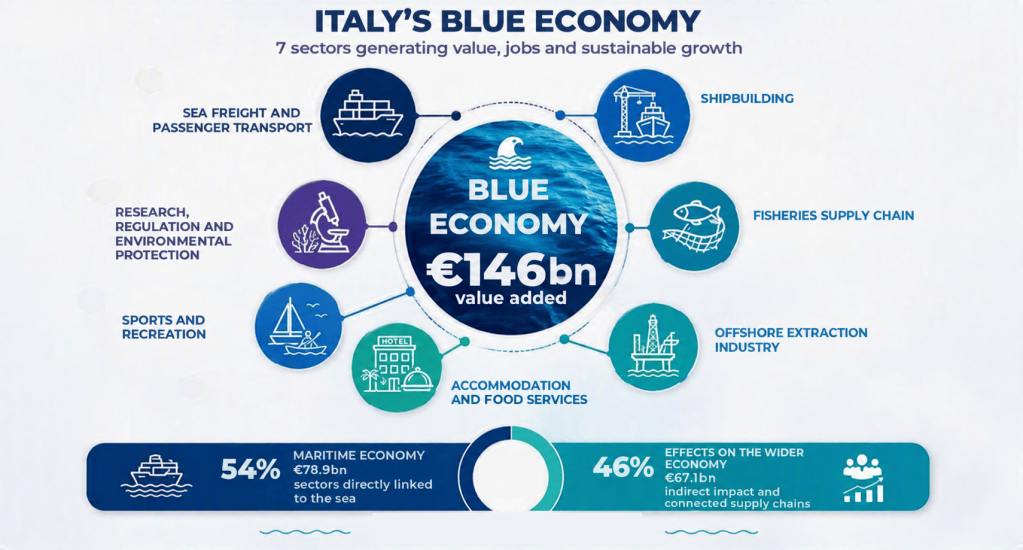
According to a SACE analysis drawing on Italy’s 2026 National Report on the Sea Economy, maritime industries comprised more than 250,000 businesses and employed 1.13 million people in 2024, the latest year for which the underlying figures were available. They produced €80 billion in direct value added. Once their links to the rest of the economy are included, the figure rises to €225 billion, 11.4% of Italy’s total value added. The broader sea economy grew by 3.8%, compared with 2.1% for the national economy.
Value added is the wealth an activity creates after the cost of the goods and services it buys is subtracted from its output. That distinction matters here: the €225 billion figure is an estimate of the direct and connected economic contribution, rather than the turnover of shipyards and ports alone. It captures how maritime demand travels inland, into manufacturing, construction, energy, digital services, research, finance and training.
The sea has returned to the center of economic strategy for structural reasons. Global supply chains are being reorganized. Energy systems are changing. Critical infrastructure must be protected. And the Mediterranean has acquired renewed importance in trade and geopolitics. Italy’s location gives it a natural stake in each of these shifts, but geography by itself cannot turn a coastline into a competitive advantage.
The South’s stake, and the multiplier beyond the coast
The maritime economy is especially consequential for the Mezzogiorno, the common Italian term for the country’s southern regions and islands. The South accounts for about 34% of the sector’s national value added and almost 40% of its employment. In coastal communities, the sea is therefore a source of jobs and business formation as well as a route to international markets.
Maritime activity is not confined to the South. Liguria in the northwest, Friuli-Venezia Giulia in the northeast, Lazio around Rome, and the islands of Sardinia and Sicily all have substantial concentrations of “blue” industries; Campania is another important hub. Their combinations differ, but ports, tourism, logistics, manufacturing and research often reinforce one another. A vessel under construction can draw on specialized firms across several regions before it ever reaches the water.
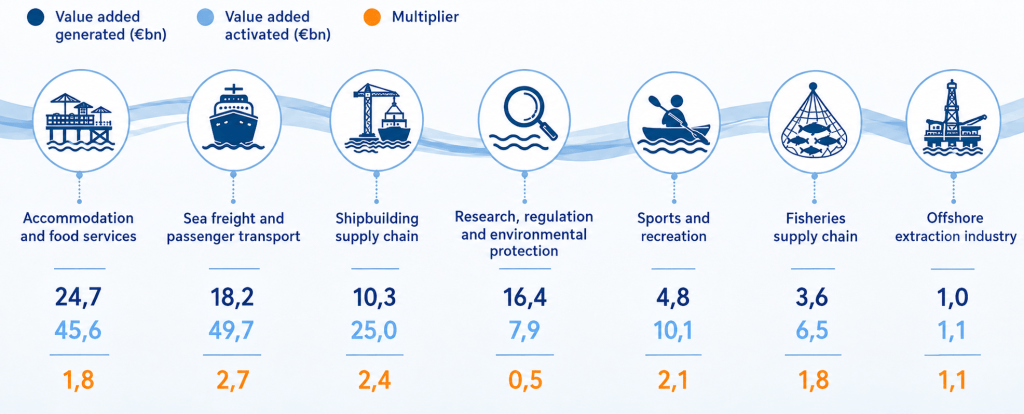
SACE estimates that each euro of value added produced directly by maritime industries activates a further €1.80 elsewhere in Italy’s economy. This multiplier is a way of describing economic connections, not a promise that every new euro of spending will automatically produce the same return. The effect also varies by activity. Cargo and passenger transport have a multiplier of 2.7, while shipbuilding has one of 2.4, reflecting their dense networks of suppliers, technology providers, infrastructure and services.
Coastal tourism, fishing, sport and recreation spread demand in different directions, from food and hospitality to interior fittings and specialized manufacturing. The expansion of maritime extraction, leisure activity, coastal tourism and transport also speaks to rising demand for energy, mobility, travel experiences and integrated logistics. The result is an economy linked by the sea but sustained by capabilities that extend well beyond it.
The Mediterranean opportunity depends on what happens inland
The stakes are magnified by the Mediterranean’s role in global commerce. Citing an April 2026 study by Confindustria and Boston Consulting Group, SACE reports that the basin carries 27% of strategic global routes, 65% of Europe’s energy supplies and 35% of worldwide crude-oil traffic. These figures illustrate why Italian ports matter to European trade, energy security and industrial resilience.
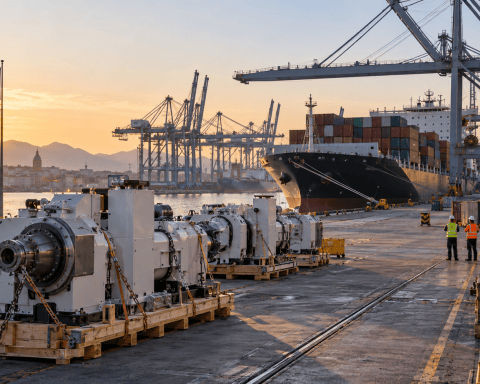
Yet a port’s value is determined partly by what happens after a container reaches the quay. Cargo must move efficiently onto trains and roads, through logistics areas behind the port and onward to factories and customers. For Italy, the challenge is to make these links work as one system. Congestion, slow transfers or weak inland connections can erode the benefit of an enviable position on the map.
SACE identifies three priorities for the wider blue economy: simpler procedures, innovation and skills. Port modernization includes electrifying berths so ships can use shore power while docked rather than run onboard generators, a practice often called cold ironing. It also includes digital systems and automation to coordinate cargo flows. The report points to reinvesting proceeds associated with the European emissions trading system, or ETS, which puts a price on covered greenhouse-gas emissions, in the maritime green transition. None of these changes works in isolation: advanced equipment requires trained people, and cleaner ports still need effective connections to the rest of the transport network.
Shipbuilding turns an industrial ecosystem into exports
Within this wider maritime landscape, Italy’s nautical and shipbuilding industry stands out for its international reach. The SACE dossier describes a production system of nearly 1,000 companies employing more than 168,000 people and generating over €13 billion in value added. Its exports account directly for 1.6% of all Italian goods exports and more than a quarter of European nautical exports. In recreational boating, Italy’s share approaches 30%.
“Nautical industry” here means considerably more than pleasure craft. It includes cruise ships, commercial vessels, boats for fishing and offshore operations, and ships for defense, as well as yachts. Each market has different customers and production cycles. What connects them is the need to integrate demanding technical work with design, high-quality components and services. A famous yard’s finished vessel is the visible result of a coordinated supply chain that may be far larger than the yard itself.
International competition is concentrated. Seven exporting countries account for roughly two-thirds of global nautical exports. In cruise ships, where the financial, engineering and production barriers to entry are particularly high, four countries account for about three-quarters of trade. Italy’s established position in these markets is valuable precisely because it is difficult to replicate. Maintaining it, however, depends on reliable delivery as much as on design or reputation.
A €10 billion export record, with different stories beneath it
In 2025, Italian vessel exports exceeded €10 billion for the first time, a 40% increase on 2024, according to the Eurostat figures presented by SACE. Growth appeared across the main segments, though their underlying trajectories were not identical.
Cruise ships generated €4.4 billion in foreign sales, more than 40% of the sector’s exports, and returned close to their 2022 peaks. The recovery coincided with cruise passenger numbers exceeding 37 million, approximately 125% of pre-pandemic levels in the measure cited by the dossier. Cruise construction is a long-cycle business: delivery commonly comes around five years after an order. That backlog has offered some protection from immediate swings in the trade environment, even though it cannot eliminate the effects of rising costs or supply disruptions.
Recreational boating also reached €4.4 billion, up 2.6% from 2024. Its upward trend has continued since 2018, apart from the interruption in 2020. Within the market, however, demand has split. Sales of large vessels over 24 meters rose 11%, while those of small craft under 7.5 meters jumped 139%; together these categories exceeded €2.6 billion. Mid-sized vessels declined 7%. Italy remains the leading country in superyachts, with more than half of the vessels currently on order under construction in Italian yards, according to SACE.
Commercial and defense vessels provided another strong contribution: exports approached €1.5 billion, up 280%, after two years of deliveries below their historical average. The size of that increase needs context. Large ships are delivered in batches after lengthy construction periods, so a quiet delivery year can make the following year’s percentage change especially dramatic. Cargo-ship sales also increased, but remained far below their 2023 peak and small beside the output of Asia’s major yards.
The United States was the largest destination overall, taking roughly a third of Italian vessel exports. For cruise ships, the US share was about 66%, followed by Germany and Switzerland. Recreational boating had a wider spread of customers, led by the United States, United Kingdom, Malta, France and Türkiye. Spain accounted for more than 60% of Italy’s foreign sales of commercial vessels. These patterns underline both the value of access to major customers and the exposure created when a segment relies heavily on a small number of markets.
Why the order book matters more than a single record year
A record export total offers a snapshot; order books reveal the work already committed for years ahead. SACE describes a global fleet that grew by an average of 5% a year from 2008 to 2025 and cites an industry turnover approaching €400 billion in 2026. The expansion of shipbuilding reflects rising trade and the need to renew fleets, including to reduce emissions. It is therefore more than a short-lived response to one favorable year.
The global shipbuilding order book exceeds $2 trillion, according to the dossier. Just under half of that value involves alternative propulsion, including liquefied natural gas, biomethane and ethanol, or hydrogen fuel-cell technologies. The term “alternative” does not mean that all these options have identical climate impacts; it describes a shift away from a fleet dependent on conventional fuels and toward a wider set of technologies. In cruise ships alone, the order book has returned to a record €80 billion after the pandemic pause in new orders. Superyacht orders are easing from their exceptional 2023–24 surge but remain historically high.
Orders can cushion yards against a sudden fall in new demand, but they create obligations that stretch years into the future. A project priced today may be delivered under different energy, labor and component costs. If a specialist supplier cannot deliver on time, a delay can ripple through the construction schedule. The question for Italy is thus how well its industrial network can execute the work already won while preparing for the next generation of vessels.
Geopolitical pressure reaches the shipyard through costs
Trade tensions have not stopped Italy’s nautical export record, and the Middle East is currently a relatively small direct market for the industry. The region accounts for only 1.1% of Italian ship sales, or 2.6% when recreational boats are included, according to SACE. The more serious potential effect of conflict in the region is indirect: higher energy and industrial costs, inflation and disrupted supply chains could slow production or lengthen delivery times in 2026 and beyond.
That distinction is crucial in an industry built around complex, multi-year contracts. A shipyard can have a healthy order book and still face pressure on margins if materials become more expensive or components arrive late. Diversifying suppliers, products and destination markets can reduce exposure, but coordination across the supply chain remains central. A delay in a propulsion system, an electrical installation or a customized interior can affect an entire vessel.
The network of subcontractors may account for a predominant share of the final cost of a cruise ship, large yacht or commercial vessel. Yards must synchronize designers, propulsion manufacturers, electrical specialists, component makers, interior suppliers and digital technology firms, sometimes across several countries. Quality, regulatory compliance and promised delivery dates all have to align. Strong suppliers help yards innovate and tailor ships to customers; skills shortages, underinvestment or interrupted deliveries can undermine both schedules and profitability.
The next voyage is built by the whole supply chain
Sustainability, digitalization and customization are the three commercial and technical levers SACE highlights for the years ahead. Italian industry association Confindustria estimates that they could help address more than €800 million in additional potential demand. Digital tools are changing how nautical companies work with customers, while after-sales service and the identity of Italian design remain part of the country’s appeal. But a more connected customer experience can only deliver on its promise if the physical production network can build and maintain what it sells.
Industrial districts and business networks, the local clusters of specialist firms long associated with Italian manufacturing, can give smaller suppliers access to scale, skills and investment while helping large yards respond to changing global demand. The same relationships can support the transition to cleaner propulsion and more efficient production. For Italy, maritime leadership is not simply a matter of having celebrated shipbuilders. It depends on whether thousands of firms can move together, absorb shocks and keep improving the product that eventually sails under an Italian name.
The 2025 export record shows the strength of that system. The broader blue economy shows why its success matters outside the shipyard gates. From southern coastal jobs to northern component makers, from Mediterranean ports to research laboratories, the sea connects parts of Italy’s economy that might otherwise seem unrelated. Keeping those connections productive will determine whether a remarkable year becomes a durable advantage.
Source: SACE, “Focus on Blue Economy e Nautica,” by Andrea de Meo and Gianmarco Schiavi, based on information available as of July 31, 2026. Figures and projections retain the dates and attributions given in the dossier.
Discover more from The Ambassador
Subscribe to get the latest posts sent to your email.