

Florence is set to offer a unique artistic journey that bridges classical heritage and contemporary vision. From September 10, 2026, to January 5, 2027, the magnificent Palazzo Medici Riccardi—a historic palace known as the cradle of the early Florentine Renaissance—will host the exhibition “Oltre il Rinascimento. Tra Dürer e Parmigianino” (Beyond the Renaissance. Between Dürer and Parmigianino). Promoted by the Metropolitan City of Florence and organized by Fondazione MUS.E, the event features a selection of about 150 works. Curated by Daniel Blau (the artist’s son), Sergio Risaliti, and Valentina Zucchi, the pieces come from the Museum of Fine Arts in Budapest and the private collection of the late Georg Baselitz, one of the most prominent contemporary artists of our time.
Palazzo Medici Riccardi is the most natural setting for this project: it is precisely here that the patriarchs of the Medici dynasty, Cosimo the Elder and Piero the Gouty, laid the foundations for the modern culture of collecting in the 15th century.
The Artist and the Collector: A Dual Perspective
The opening of this exhibition briefly overlaps with another major cultural event in the city. Just three days before “Baselitz. AVANTI!” concludes on September 13, 2026, at the Museo Novecento (Florence’s museum dedicated to 20th and 21st-century art), this new showcase opens its doors. This overlap provides a rare opportunity for visitors to experience two complementary sides of the German master. While the Museo Novecento highlights Baselitz the artist, who used graphic art as an independent medium for continuous experimentation and transformation, Palazzo Medici Riccardi reveals Baselitz the passionate collector and connoisseur of ancient masters.
For Baselitz, destructuring images was a deliberate choice to dismantle the aesthetics associated with the power of the Third Reich. His original reinterpretation of these historic works aims to exalt human vulnerability against oppressive forms of power, offering a poignant message for the modern era.

The Genesis of the Exhibition and the Budapest Connection
Baselitz’s dedication to historical prints was not a passing hobby; it was a profound interest cultivated over six decades, beginning in 1964 with the purchase of “The Sacrifice” by Antonio Fantuzzi da Trento. The Florentine exhibition actually stems from a preceding show, “The Mannerist Mind. Prints from the Georg Baselitz Collection,” held between late 2025 and early 2026 at the Museum of Fine Arts in Budapest.
Baselitz shared a deep bond with the Hungarian institution: they dedicated a monographic exhibition to him in 2017, and three years later, he donated thirty engravings to their collections. This exhibition places a public institution’s collection side-by-side with an artist’s private collection, inviting visitors to reflect on the very impulse to preserve, study, and share art.
Discovering Mannerism Through Graphic Art
For those unfamiliar with the term, Mannerism was a late-Renaissance art movement that deliberately broke away from the harmonious, classical ideals of the High Renaissance to embrace artificiality, eccentricity, and complex aesthetics. Baselitz was deeply attracted to the unconventional approach, creative freedom, and striking dissonances of Mannerist graphic art. Printmaking and engraving are sometimes wrongly considered a “minor art,” but this exhibition proves they were the fundamental tools for artistic creation and the circulation of ideas across 16th-century Europe. The curators highlight how these artists pushed classical traditions toward unexpected results, often using the human figure as a “field of tension”.
Masterpieces on Display: A Walkthrough of the Exhibition
The exhibition path winds through time and space, offering a “kaleidoscope of sensitivities” that circulated throughout Europe. Visitors will be able to admire specific masterpieces, including:
- The iconic Rhinoceros and other famous prints by German master Albrecht Dürer.
- A large series of works by Lucas Cranach the Elder, displayed alongside a rare, original woodblock matrix.
- Powerful chiaroscuro (light and shadow) prints by Domenico Beccafumi and Ugo da Carpi, including the famous depiction of Diogenes.
- A series of prints derived from a lost painting by Giuseppe Arcimboldo, one of which serves as the visual icon of the entire exhibition.
- Special attention given to the research of Parmigianino, particularly focusing on the iconographic theme of the Deposition of Christ.
- Pioneering late 15th-century works by Italian masters Antonio del Pollaiolo and Andrea Mantegna.
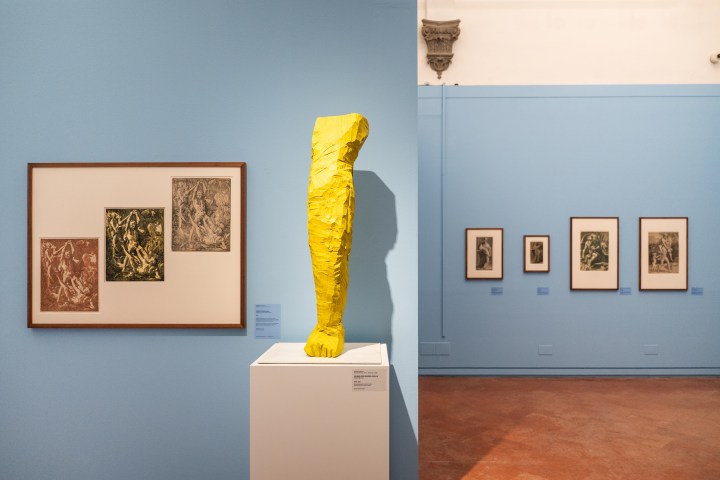
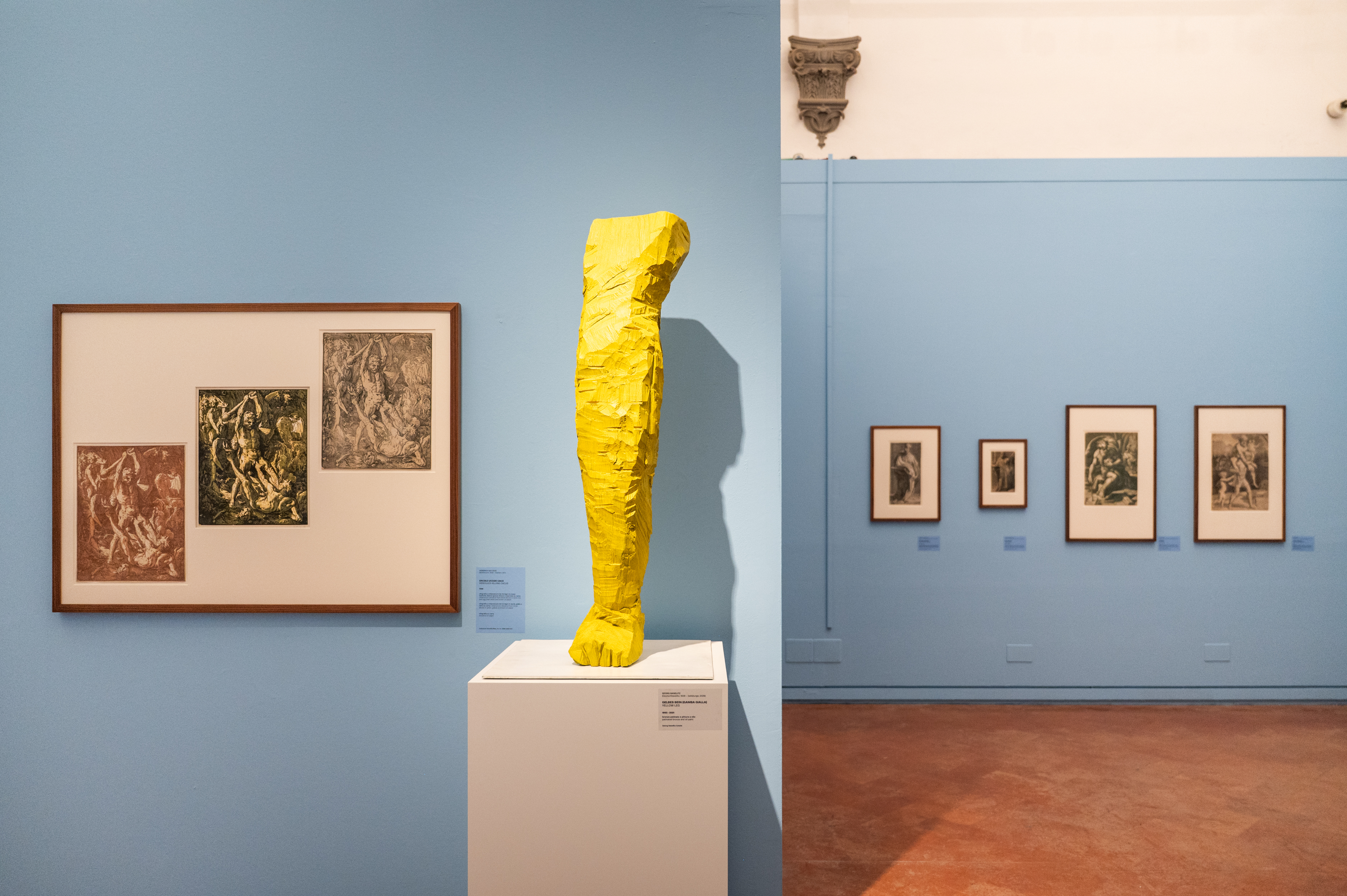
To bridge the gap with the contemporary world, four sculptures by Baselitz himself, along with his eloquent self-portrait, are placed strategically among these historical prints
A Journey Spanning Decades of Collecting
Baselitz’s dedication to historical prints was not a passing hobby; it was a profound interest cultivated over six decades. His collection began in 1964 with the purchase of “The Sacrifice” (Il sacrificio) by Antonio Fantuzzi da Trento, a print that reinterprets a famous Mannerist painting from the School of Fontainebleau. Visitors can now admire works by late 15th-century and 16th-century innovators such as Andrea Mantegna, Parmigianino, and Albrecht Dürer. The exhibition also features French engravers like Léon Davent and masters of chiaroscuro (light and shadow) prints, such as Ugo da Carpi and Domenico Beccafumi. To beautifully bridge the gap with the contemporary world, four sculptures by Baselitz himself, along with his eloquent self-portrait, are placed among these historical prints.

A Final Tribute and a Deep Bond with Florence
Florence played a crucial role in Baselitz’s life and art. The artist, who passed away just a few months prior to this exhibition, even spent six months studying in the city on a scholarship at the Villa Romana. According to Florence’s Mayor, Sara Funaro, this exhibition pays tribute to the recently deceased master and highlights how his passion for Mannerist graphics intertwined with his own art, which sought to highlight human vulnerability against oppressive forms of power like the Third Reich.
Daniel Blau noted that his father’s work would have been completely different without the time he spent in Florence. Baselitz deeply loved his collection of prints and hoped to see them exhibited in the city he cherished so much. Reflecting on his father’s passing, Blau shared a touching thought that the artist expressed shortly before his death: “Up there, there will surely be a small open window. I will be watching from there”.
Discover more from The Ambassador
Subscribe to get the latest posts sent to your email.