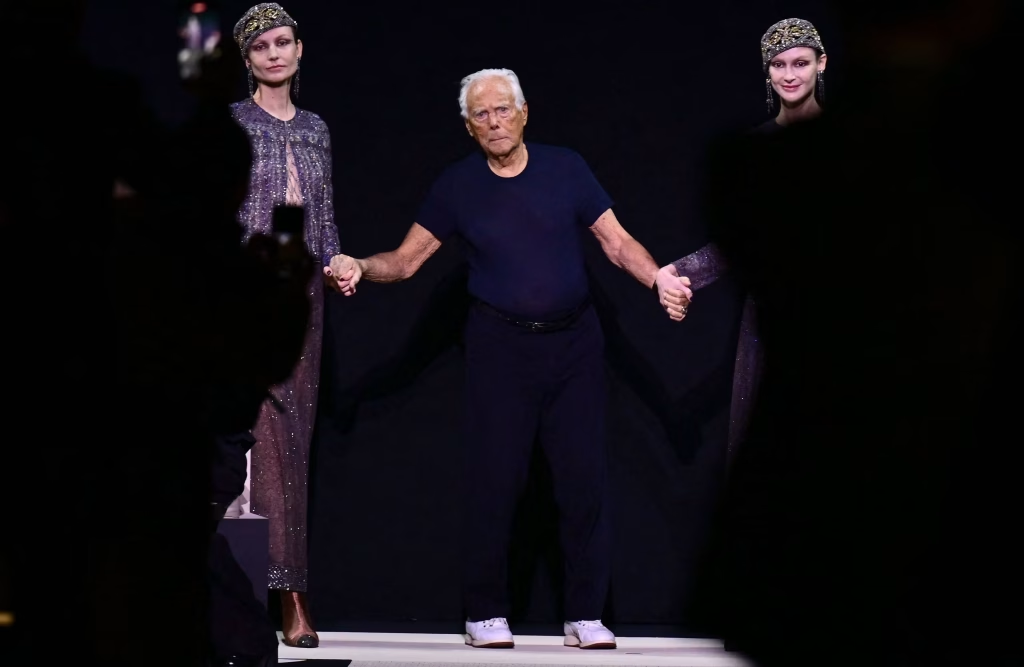
The membership committee at Casa Cipriani Milano meets every Tuesday at 3 PM. Applications have tripled since 2023. Russian oligarchs, Chinese tech founders, American hedge fund managers, and Middle Eastern royalty—all competing for fifteen luxurious rooms and members-only access where Milan’s new international elite conducts business over Bellinis.
“We’re not approving based on wealth anymore,” confides a committee member. “Everyone applying has wealth. We’re looking for cultural fit—people who understand Milan isn’t Monaco. This is a city with soul.”
Recent reports indicate Italy attracted thousands of high-net-worth individuals in 2024—with Milan capturing the majority, concentrated in the Quadrilatero and Brera districts. This launches a two-year research project documenting the Italian opportunity through comprehensive database intelligence. First: understanding why Milan is winning.
The CR7 Rule: €200,000 Buys Everything
When Cristiano Ronaldo joined Juventus in 2018, he became poster child for Italy’s “impatriati” regime. The CR7 Rule offers new residents a flat €200,000 annual tax on unlimited foreign income for fifteen years. Whether you earn €5 million or €500 million internationally—Italian tax exposure caps at €200,000.
The mathematics compel even skeptics. A London fund manager earning €20 million annually faces UK taxes approaching €9 million. In Milan? €200,000. Annual savings: €8.8 million. Over fifteen years: €132 million.
The real advantage is inheritance exemption. Foreign assets remain outside Italian estate taxation. For multi-generational wealth, this transforms Milan from tax-efficient residence into dynasty-planning jurisdiction. Cayman structures, Swiss accounts, Singapore portfolios—all untouched while enjoying European residency with Italian citizenship pathways.
Despite doubling the flat tax from €100,000 to €200,000 in 2024, demand hasn’t slowed. As one wealth advisor notes: “At this level, €200,000 is irrelevant. Protecting €200 million matters.”
The Club Renaissance: Where Deals Happen
September 2024 marked Milan’s social transformation. During Fashion Week, the city’s sciure—well-to-do ladies—remained preoccupied with pending club membership applications. Waiting list culture has arrived.
Casa Cipriani opened with just fifteen rooms and immediate exclusivity. The Pickering Room became where venture capital meets fashion capital meets old money. Membership grants access to global Casa Cipriani network: New York, Miami, London.
The Wilde launched targeting creative industries and entrepreneurs, embracing Milan’s design-forward aesthetic with rooftop Duomo views. Summer evening venue for deals that won’t hit Bloomberg terminals for months.
Bulgari Hotel Milano remains establishment power. The bar is where Italian industrial families, international investors, and luxury brand executives maintain permanent tables. If Cipriani represents new money energy, Bulgari represents old money continuity.
These aren’t amenities—they’re infrastructure. Where everyone has capital, access determines outcomes.
Michelin Stars and €15 Miracles
Seta at Mandarin Oriental holds two Michelin stars under chef Antonio Guida—one of Milan’s most coveted tables. The €350 tasting menu books months ahead, but real value is the eight-seat chef’s table where Guida personally explains courses. When entertaining Asian investors, this isn’t dinner—it’s cultural diplomacy.
Contraste’s Thomas Piras deconstructs traditional dishes while respecting essence. His €200 tasting menu attracts international chefs on pilgrimage.
But Milan’s secret remains €50 exceptional meals. Ratanà in Porta Nuova serves Milanese tradition elevated through technique. Al Matarel maintains three generations of family recipes. Tuesday lunch might seat you beside Armani executives and Pirelli board members eating the €15 daily special because it’s genuinely excellent.
The Real Estate Mathematics
Reports indicate Milan property prices have surged significantly over the past decade, with the city now commanding some of Italy’s highest real estate values. Current averages in prime districts substantially exceed other Italian cities like Rome.
A 300-square-meter Brera apartment—eighteenth-century frescoes, twenty-foot ceilings, palazzo courtyard—commands €4-5 million. That money buys 150 square meters in Mayfair or 180 in Paris’s 6th. The Milan property includes history, architecture, and location three blocks from La Scala.
CityLife’s Zaha Hadid tower—250 square meters, floor-to-ceiling windows, 170,000 square meters of parks—costs €2.5-3 million. Comparable London new-build starts at £8 million.
Olympic development zones offer ground-floor opportunity. Santa Giulia and Porta Romana receive €2 billion infrastructure investment through 2026. Current entry: €7,000-9,000 per square meter. Based on Expo 2015 precedent, expect 25-40% appreciation by 2027.
The sophisticated play: maintain multiple properties. A Brera pied-à-terre for city life, Lake Como villa for summer, Cortina apartment for skiing. Total investment: €10-15 million versus €15-20 million for equivalent London footprint.
The Olympic Infrastructure Catalyst
The 2026 Winter Olympics operating budget reaches €1.7 billion, but the real transformation comes from parallel infrastructure investments in transportation, venues, and urban development.
Malpensa expansion to forty million passengers adds direct routes: Singapore (October 2025), Seoul, Mumbai, additional Chinese cities. Private aviation infrastructure doubling with dedicated FBO facilities.
High-speed rail improvements reduce Milan-Cortina to 2 hours 45 minutes. Milan-Zurich in 3 hours 20 minutes makes Swiss banking day trips practical without flying.
Olympic villages become mixed-use neighborhoods post-2026—apartments, offices, retail, parks. The model follows Barcelona 1992 and London 2012: industrial zones transformed into desirable districts.
Smart city integration brings Asian-level technology: digital parking, integrated transit, IoT public services.
The Milano-Cortina Weekend: €3,500
A typical winter weekend reveals the value proposition:
Friday: Seta dinner (€500pp with wine), car service (€50). Saturday: Private car to Cortina (€400), ski passes and equipment (€200), mountain lunch (€150), hotel suite (€800), Michelin dinner (€300). Sunday: Full ski day (€200), return to Milan (€400).
Weekend total: €3,500 for two.
Compare Zurich-to-Gstaad: similar costs but higher accommodation (€1,200+), more expensive dining (€400+), and significantly higher annual taxes. The Milan weekend costs similarly but you’re saving €8 million annually.
Summer transforms options: Lake Como by helicopter (15 minutes, €800), Portofino by car (3 hours), Venice by rail (2.5 hours). Geographic centrality enables variety impossible elsewhere.
The International Architecture
The new Milanese elite breaks into distinct communities:
Russian entrepreneurs seeking European stability, concentrated in CityLife. Chinese families—fastest-growing segment—establishing Mandarin infrastructure and Shanghai-Shenzhen business networks. American expats split between tech founders and finance executives. British relocation accelerated post-Brexit—hedge fund managers and luxury brand executives enjoying 70% tax savings. Middle Eastern families using Milan as European base.
The magic happens in overlapping networks. Children attend school across nationalities. Weekend ski trips mix cultures. Casa Cipriani dinners create cross-border deal-flow. Milan’s international density creates relationship opportunities unavailable in homogeneous cities.
The Two-Year Database Vision
This analysis launches comprehensive research documenting Italian opportunity. Future coverage: Rome’s political capital advantages, Florence Renaissance living, Turin industrial sophistication, Como residential reality, coastal opportunities, hidden gem cities.
Operational intelligence: complete bureaucratic navigation, healthcare optimization, international schools, language acquisition, banking relationships, property acquisition, tax residency, legal structures.
Lifestyle documentation: regional wine collecting, automotive culture, art acquisition, opera access, private aviation, yacht ownership, Italian business culture, social integration.
Investment analysis: real estate dynamics, alternative assets, startups and VC, family office establishment, multi-generational planning, succession, banking privacy.
This isn’t tourism content—it’s operational intelligence for wealth deployment and lifestyle optimization.
The Invitation
Milan’s transformation represents Europe’s most significant demographic shift since Brexit. Coming years offer exceptional timing—Olympic infrastructure completing, international community reaching critical mass, real estate affordable relative to London, Paris, Geneva.
Success requires understanding nuances beyond tax headlines. Which neighborhoods matter? Which schools work? Which clubs provide access? Which advisors deliver? Which mistakes cost years?
This research series answers comprehensively. Follow this journey documenting international relocation to Italy. Share experiences, questions, insights. Together we’ll build the definitive resource.
The wealthy have discovered Milan. The question is whether you’re positioned to capitalize before the window closes.
Part of a two-year research project documenting Italian living for international residents. For detailed insights or to contribute your experience, contact us to join the most comprehensive Italian relocation intelligence available.
Discover more from The Ambassador
Subscribe to get the latest posts sent to your email.