


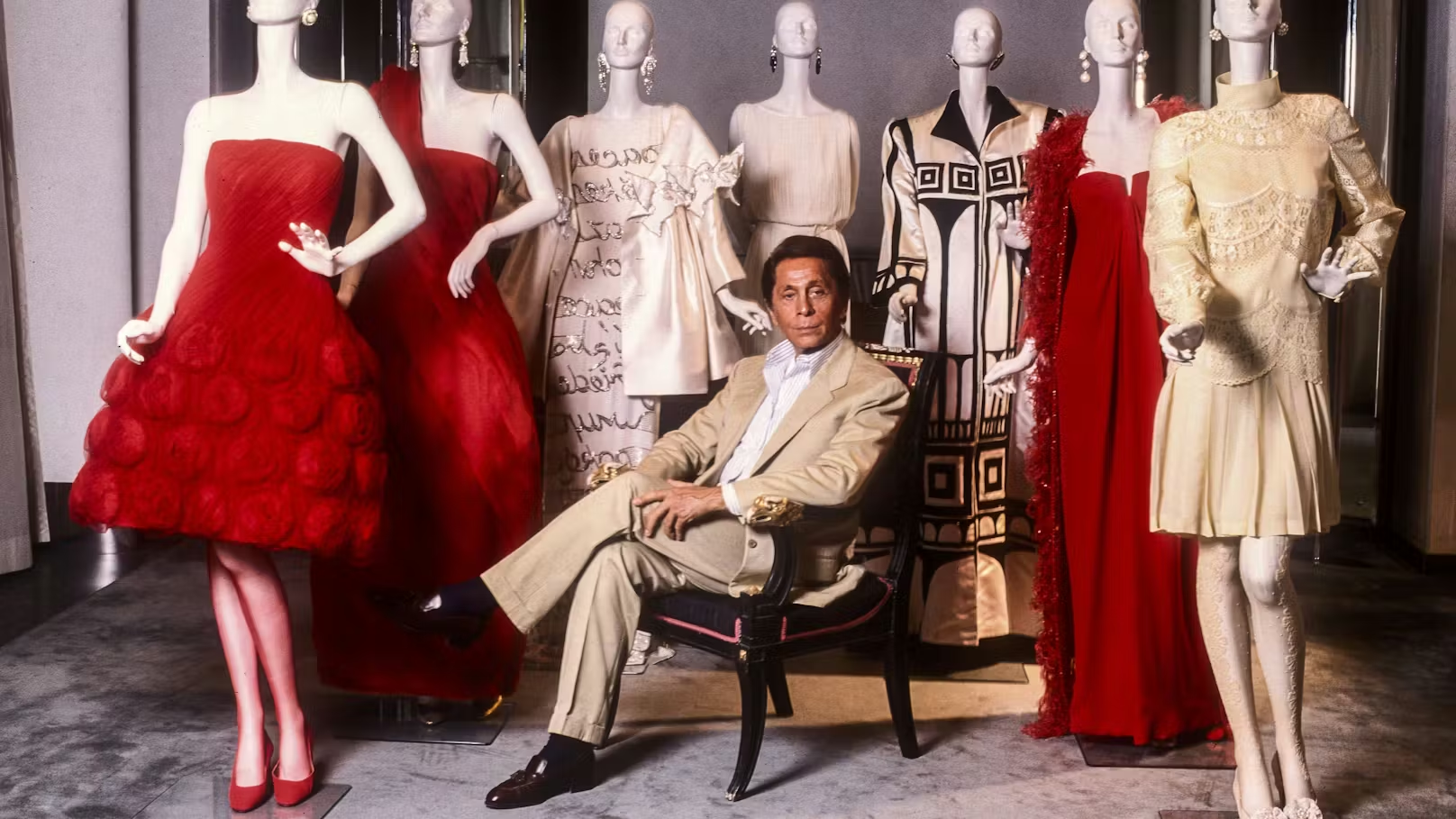
The silence that has descended upon Rome is deafening. It is a silence not of emptiness, but of a heavy, velvet curtain falling upon the grandest stage the world of fashion has ever known. Only a few months have passed since we mourned the loss of Giorgio Armani, the architect of deconstructed elegance, and now, Italy finds itself orphaned once more. Valentino Garavani, the Last Emperor of Haute Couture, has left us. If Armani was the disciplined rigour of Milan, the subtle greige that redefined power, Valentino was the opulence of Rome, the explosion of colour, the unapologetic pursuit of absolute beauty. Together, they were the dual soul of the Italian Renaissance in fashion; with both gone, we stand at the threshold of a new, uncertain world, looking back with nostalgia at an age of giants that will likely never be repeated.
From Voghera to Paris: The Making of a Couturier
To understand the magnitude of this loss, one must retrace the steps of a young man from Voghera, born in 1932, whose dreams were too vivid for the grey scale of post-war reality. From his earliest days, Valentino did not merely want to dress women; he wanted to adorn them, to elevate them to the status of deities. His journey to Paris as a young man was a pilgrimage to the holy land of couture. There, studying at the École des Beaux-Arts and the Chambre Syndicale de la Couture Parisienne, and apprenticing under masters like Jean Dessès and Guy Laroche, he did not just learn the craft; he absorbed a philosophy. He learned that a dress is not a covering, but an architecture of fabric designed to defy gravity and time. Yet, unlike many of his contemporaries who stayed in France, Valentino felt the pull of his homeland. He returned to Rome in 1960, just as the Eternal City was blossoming into the capital of “La Dolce Vita.”
The Strategic Partnership with Giancarlo Giammetti
It was in Rome, on the legendary Via Condotti, that the legend truly began. But art, no matter how sublime, requires a vessel to carry it into the world. That vessel was Giancarlo Giammetti. Their meeting was serendipitous, a collision of stars that would alter the trajectory of global luxury. While Valentino was the dreamer, the artist who could envision a gown in the drape of a fabric, Giammetti was the strategist, the mind that understood that for the dream to survive, it had to be profitable. This partnership remains one of the most successful in the history of fashion business. Together, they navigated the turbulent waters of the industry, transforming a Roman atelier into a global powerhouse. They pioneered the concept of branding long before it became a marketing buzzword, understanding that the designer’s personality was as marketable as the clothes themselves.
The 1968 White Collection and Global Stardom
The turning point, the moment the name “Valentino” became synonymous with unparalleled chic, came in 1968 with the “White Collection.” At a time when the world was exploding in psychedelic colours and chaotic prints, Valentino dared to strip everything away. He presented a collection entirely in shades of white, cream, and ivory. It was a masterclass in technique, where the lack of colour highlighted the perfection of the cut, the intricacy of the pleating, and the signature “V” logo that would soon adorn the most coveted accessories on the planet. It was a bold financial risk and an artistic triumph, proving that true luxury whispers rather than shouts.
The Legend of ‘Rosso Valentino’
And yet, despite the triumph of white, history will remember him in Red. “Rosso Valentino” is not merely a colour; it is a cultural institution. It is a specific blend of 100 per cent magenta, 100 per cent yellow, and 10 per cent black. It is the colour of passion, of blood, of life itself. Valentino often said that a woman dressed in red can never be ignored, and he spent a lifetime ensuring that the women he dressed were the center of every room they entered. He treated the female form with a reverence that bordered on the sacred, rejecting the grunge and minimalism that would later sweep the industry in favor of a timeless, romantic femininity.
Dressing Icons: From Jackie Kennedy to the Supermodels
His client list reads like a history of the 20th and 21st centuries. He did not just dress celebrities; he dressed icons. When Jacqueline Kennedy married Aristotle Onassis, she wore Valentino, cementing his status as the couturier to the global elite. He clothed the violet eyes of Elizabeth Taylor and the ethereal grace of Audrey Hepburn. But his genius was not stuck in the past. As the era of the Supermodels dawned in the 1990s, Valentino was there, flanked by the likes of Naomi Campbell, Claudia Schiffer, and Elle Macpherson. He understood the power of the image, the symbiosis between the designer and the muse. He adored them, and they, in turn, worshipped him. Who could forget the images of him taking his final bow, surrounded by a legion of women in red, a king among his queens?
Financial Acumen and Corporate Evolution
Beyond the glamour, however, lies a business legacy that is equally impressive. Valentino and Giammetti demonstrated an acute financial acumen. They sold the company in 1998 to HdP for a staggering sum, later passing to the Marzotto Group, and eventually to Mayhoola for Investments. Throughout these corporate shifts—often traumatic for other fashion houses—the brand’s identity remained pristine. Valentino proved that “Made in Italy” was not just a label of origin, but a guarantee of financial value and heritage. He showed that high craftsmanship could coexist with high finance, paving the way for the modern luxury conglomerates we see today.
The Last Emperor: A Legacy Beyond Retirement
When he announced his retirement in 2008, the world gasped. The documentary “The Last Emperor” captured those final days with a poignancy that brought tears to the eyes of fashion lovers everywhere. It showed a man who was arguably the last of his kind, a couturier who still draped fabric with his own hands, who demanded perfection from his seamstresses not out of cruelty, but out of a shared love for the art. His farewell show in Paris was not a funeral, but an apotheosis—a celebration of forty-five years of beauty. Since then, while he stepped back from the cutting table, his spirit never left the Maison.
A Life Dedicated to Beauty and Style
He was a man of exquisite taste, not just in clothes, but in life. His homes, from the Château de Wideville near Paris to his villa in Rome, were museums of impeccable interior design, filled with art and surrounded by his beloved pugs. He lived deeply, surrounding himself with beauty as a shield against the mundane. He was curious, funny, and occasionally tempestuous—traits that only endeared him more to those who understood that his temper was born of passion.
Farewell to the King of High Fashion
Today, as we bid farewell to Valentino Garavani, we are not just saying goodbye to a man. We are saying goodbye to the idea that fashion is art. We are saying goodbye to the Jet Set era, to the nights in Capri and Gstaad, to the rustle of silk taffeta and the sparkle of hand-sewn sequins. Losing Armani was a blow to the intellect of fashion; losing Valentino is a blow to its heart.
The Imperishable Future of Made in Italy
The “Made in Italy” brand stands strong today because men like Valentino built its foundations with iron will and silk thread. He taught the world that Italian style is not just about looking good; it is about living well. It is a philosophy of warmth, of drama, and of enduring elegance. Though the man has departed, the Red remains. In every atelier where a young student pins fabric to a mannequin, in every red carpet moment that stops the breath, and in the very DNA of Italian culture, Valentino lives on. The Emperor is dead, but his empire of beauty is imperishable. Addio, Maestro. The world is a little less colourful today, but you have left us enough beauty to last forever.
Article written with help of AI
Discover more from The Ambassador
Subscribe to get the latest posts sent to your email.


